Last week, the company recalled two million cars due to the Autopilot system.
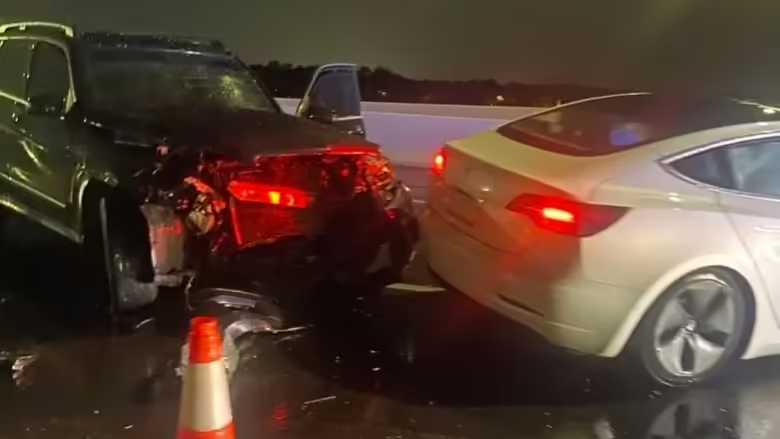
A study conducted by Lending Tree on 30 car brands revealed that Tesla cars were the most accident-prone over the past year.
The researchers analyzed quotes from people looking to insure their own cars, and did not include accident data, or accidents involving rental car drivers, a LendingTree spokesperson told CNBC, as seen by Al Arabiya Business.
“It is difficult to pinpoint why some brands have higher accident rates than others,” the study said. “However, there is evidence that certain types of vehicles attract more risky drivers than others
With 24 crashes per 1,000 drivers from mid-November 2022 to mid-November 2023, Tesla drivers had the worst crash rate in the United States, followed by RAM drivers who were involved in about 23 crashes, and Subaru drivers who were involved in about 21 crashes per 1,000 drivers during the year.
In contrast, Pontiac, Mercury and Saturn drivers all had less than 10 crashes per 1,000 drivers during the study period.
BMW drivers were the most likely to engage in drunk driving, the researchers found. They were involved in about 3 drunk driving deaths per 1,000 drivers per year, about twice the rate of drunk driving deaths among Ram drivers, who were the second worst drivers.
For overall driving incidents, which included not only accidents but also DUIs, speeding and other citations, Ram drivers had the highest accident rate, while Tesla drivers had the second-highest accident rate in the United States.
Accidents, DUIs, speeding and other citations can all drive up insurance rates for drivers. Lending Tree found that a single speeding ticket can raise auto insurance rates by 10% to 20%, accidents can increase rates by about 40%, and drunk driving can cause rates to increase by 60% or more.
Lending Tree’s findings on drivers with the highest accident rates by vehicle brand come on the heels of Tesla’s withdrawal of its Autopilot software in the US that affected about 2 million of the company’s electric vehicles.
Musk has also promoted Tesla’s systems as if they are already or soon will be safe to use without driver supervision — yet Autopilot and Full Self-Driving still require Tesla drivers to remain attentive to the road and ready to steer or brake in response at all times.
A two-year investigation by the National Highway Traffic Safety Administration found that Tesla’s Autosteer feature, which is part of Autopilot and FSD, has safety flaws that could cause an “increased crash risk.” NHTSA said it found that Tesla drivers can easily misuse the cars’ Autosteer feature and may not even know if it’s on or off.
According to filings with the Federal Motor Vehicle Safety Authority, Tesla disagreed with NHTSA’s findings but agreed to a voluntary software recall and promised to make safety improvements to Autosteer through “over-the-air” updates. The updated software will make drivers pay more attention to the road and prevent drivers from using Autopilot if Tesla’s systems detect irresponsible use.